Sour Milk, Not Beer, Likely Filled Pots Left in Danish Giants' Halls
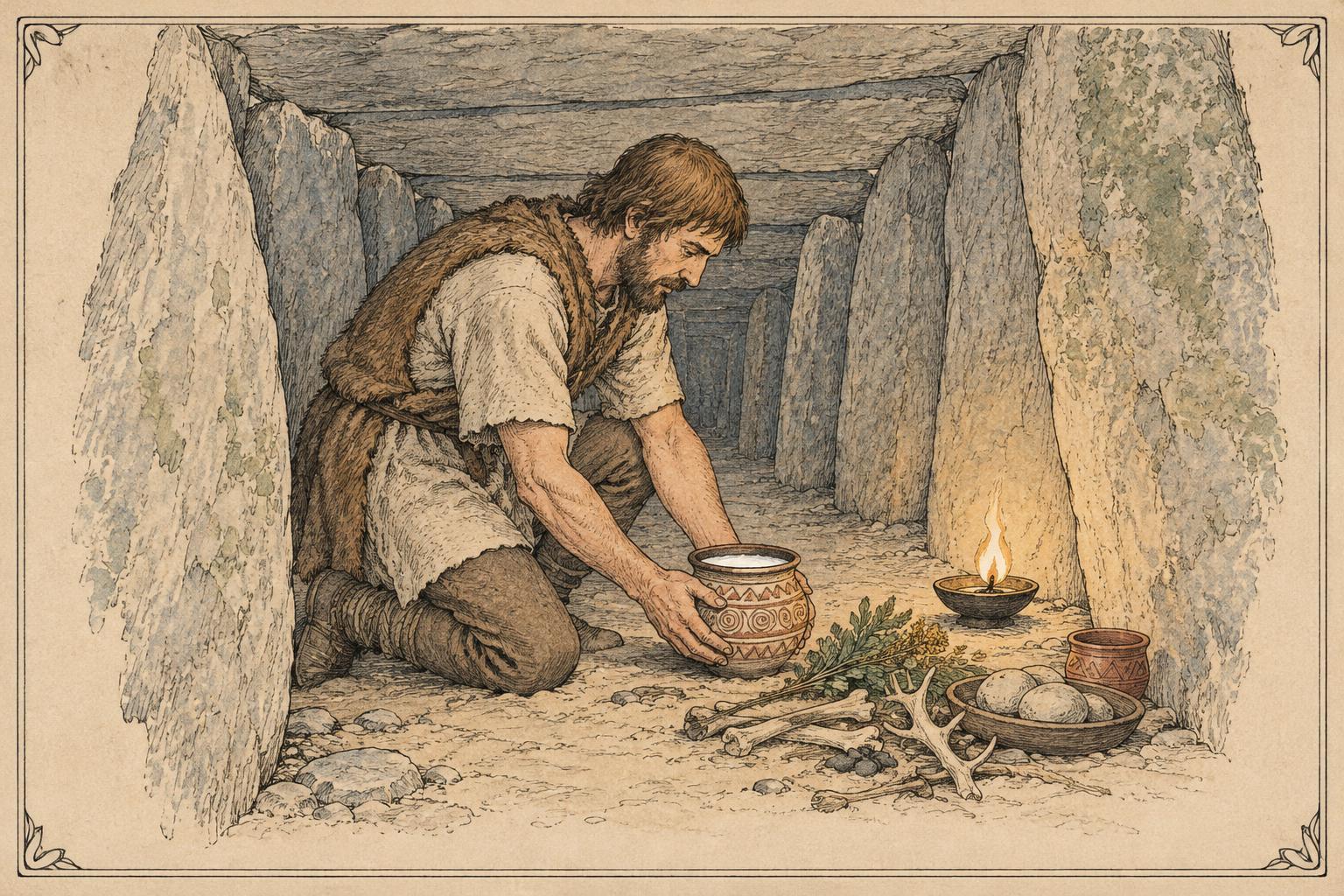
Pottery placed in Danish passage tombs about 5,000 years ago probably held fermenting milk rather than beer. That is the result of a study in Antiquity by Lone Claudi-Hansen of Museum Vestsjælland and the University of Copenhagen, and Adam Cordes of the National Museum of Denmark and Aarhus University.
The team examined 330 vessels of the Funnel Beaker culture from western Zealand, dated to roughly 3300 to 2800 BC. They came from tombs, settlements and peat bogs. Thirty-one showed corrosion of the interior surface, with small pits and flaking clay. Of those, 29 came from burial chambers.
The pattern was sharp. The marks appeared in all five tombs studied. They were missing on sherds left beside the entrances, and only one of 143 settlement vessels showed them. Most affected pieces were fine, richly decorated ware from about 3200 to 2900 BC. Claudi-Hansen and Cordes read this as selective use and deliberate deposition.
Cordes studies prehistoric brewing, and beer was the starting hypothesis. To test it, potter Inger Heebøll made nine replicas at Sagnlandet Lejre. She used clay tempered with crushed granite and sand, fired at about 650 °C. Seven pots held liquids for ten weeks in autumn 2024: raw milk, whey, kefir, vinegar, fermenting beer, mead and water. Two more were used for shorter beer batches.
Raw milk came closest to the tomb pots. It produced pitting, flaking and stains that merged into corroded patches. Whey and kefir roughened the surface. Neither beer nor mead did anything similar.
There are limits. The replicas were unsealed, so damage showed mostly on the outside, while the ancient pots are worn on the inside. The authors accept that sealed originals could have corroded inward, though they call that speculative. Surface wear cannot name a substance with certainty, each liquid was tested about once, and 13 of the 31 pots carry thin brown crusts whose meaning is unknown.
Milk makes sense as a food. Adults in early farming communities generally could not digest lactose. Fermenting milk and draining off whey lowers it. The authors picture a curdled product like kefir or skyr. Niels H. Andersen of the Moesgaard Museum notes that no firm trace of brewing in Denmark is known before the Bronze Age.
The finding suggests that the tomb offerings were chosen for what the pots had held. Soured dairy food may have carried ritual weight in how these farmers honored their dead. It is a reminder that old vessels can preserve evidence of ritual meals even when the food itself is long gone.
Compiled from the reports below. Read the originals.
Sources
- November 25, 2026
- November 26, 2026