Sand Body Found in Sutton Hoo's Garden Field Cemetery
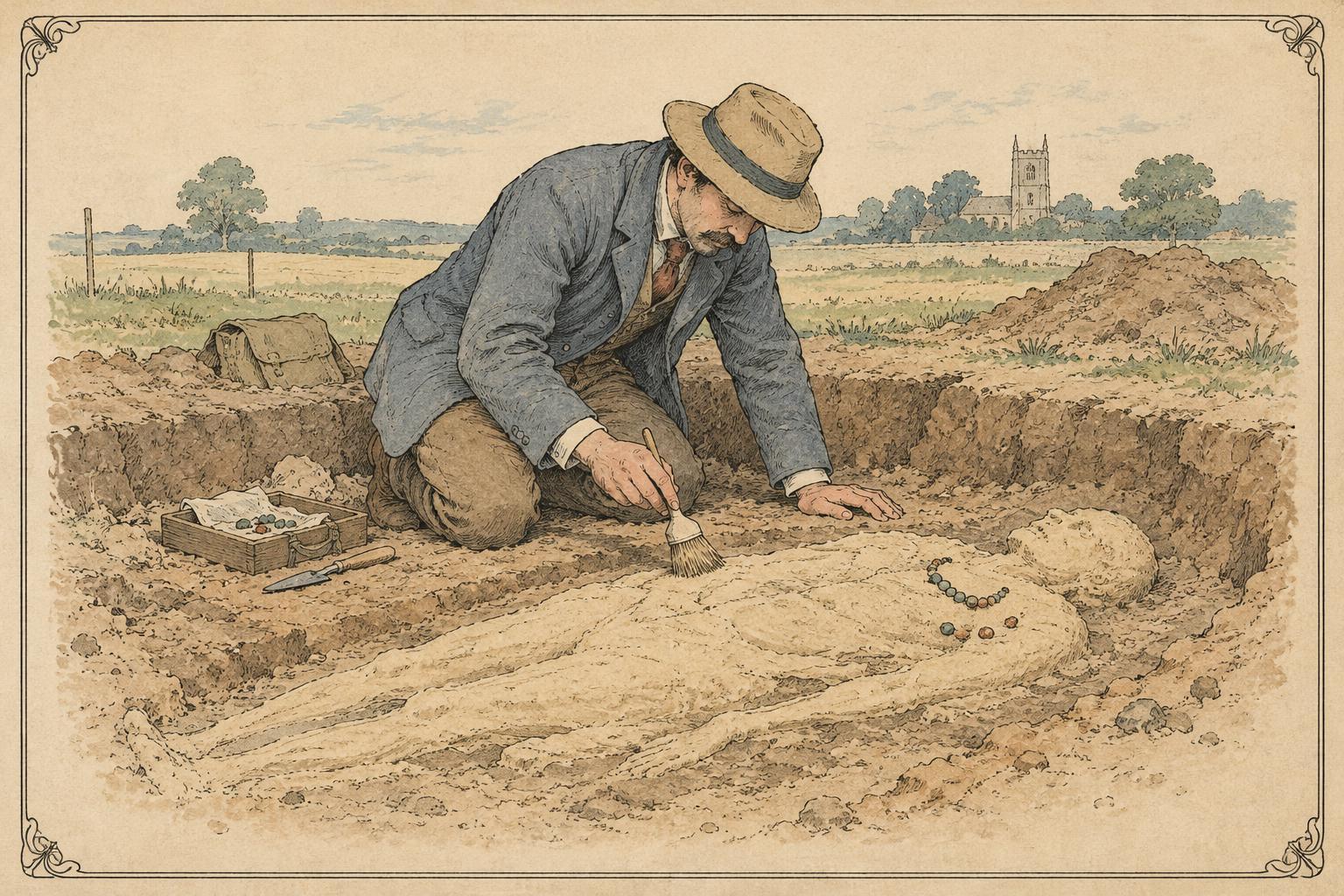
Excavators at Sutton Hoo have found a so-called sand body, a human-shaped form left in the ground about 1,400 years ago. The bones and flesh are gone. Hardened sand still holds the outline of the person who was buried.
The grave lies in the Garden Field cemetery. The find came in the last week of a month-long dig in 2025. Beside the deceased were a few grave goods: beads, tweezers, a knife and a brooch. Under the sand body, the team found signs that a second person may have been placed in the same grave.
Angus Wainwright, an archaeologist with the National Trust, explained how the form survived. The acid soil dissolved the bodies and bones, and hard sand took their place. He compared the result to some of the bodies at Pompeii. The process is different there. Ash set around the dead, and decay left hollows that were later filled with plaster. Wainwright called the find "a high point" of the dig.
Sand bodies have turned up at Sutton Hoo before, and at other Anglo-Saxon sites in Suffolk. Experts think the sand burials and cremations in this cemetery may be older than the famous ship burial. That burial dates to the seventh century and may be that of King Raedwald of East Anglia, who died around AD 627.
The dig was filmed for a four-part Time Team series made with the National Trust and FAS Heritage. Its first episode went online on 14 November. The 2025 season set out to learn how far the cemetery extends, when it was used, and whether those buried there were linked to the ship burial's occupant. Early results suggest the people of Garden Field were gaining wealth and status. At least one was buried with a gold ingot. The team also examined possible remains of a dock on the River Deben and found a decorated fragment of a cremation urn, which surprised them.
An earlier season produced the Bromeswell Bucket, a copper-alloy vessel from Byzantine lands, probably of the sixth century. A hunting scene with North African warriors decorates it. It had been reused as a cremation container. Inside were an ankle bone, skull fragments and the remains of an animal larger than a pig. Horses often went onto early Anglo-Saxon pyres as a mark of rank.
Time Team's Anglo-Saxon specialist Helen Geake said the central puzzle has been why and when this place was chosen. She added that many questions remain. Researchers now hope to learn the age and status of the sand body's occupant, and how that person relates to the second burial.
The find shows how evidence can outlast the thing it records. Soil that destroys bone can still leave a precise mark of a person, and careful excavation can read it.
Compiled from the reports below. Read the originals.
Sources
- November 20, 2026
- November 23, 2026