Westminster Abbey's Roman Coffin Likely Held a Late Saxon Abbot
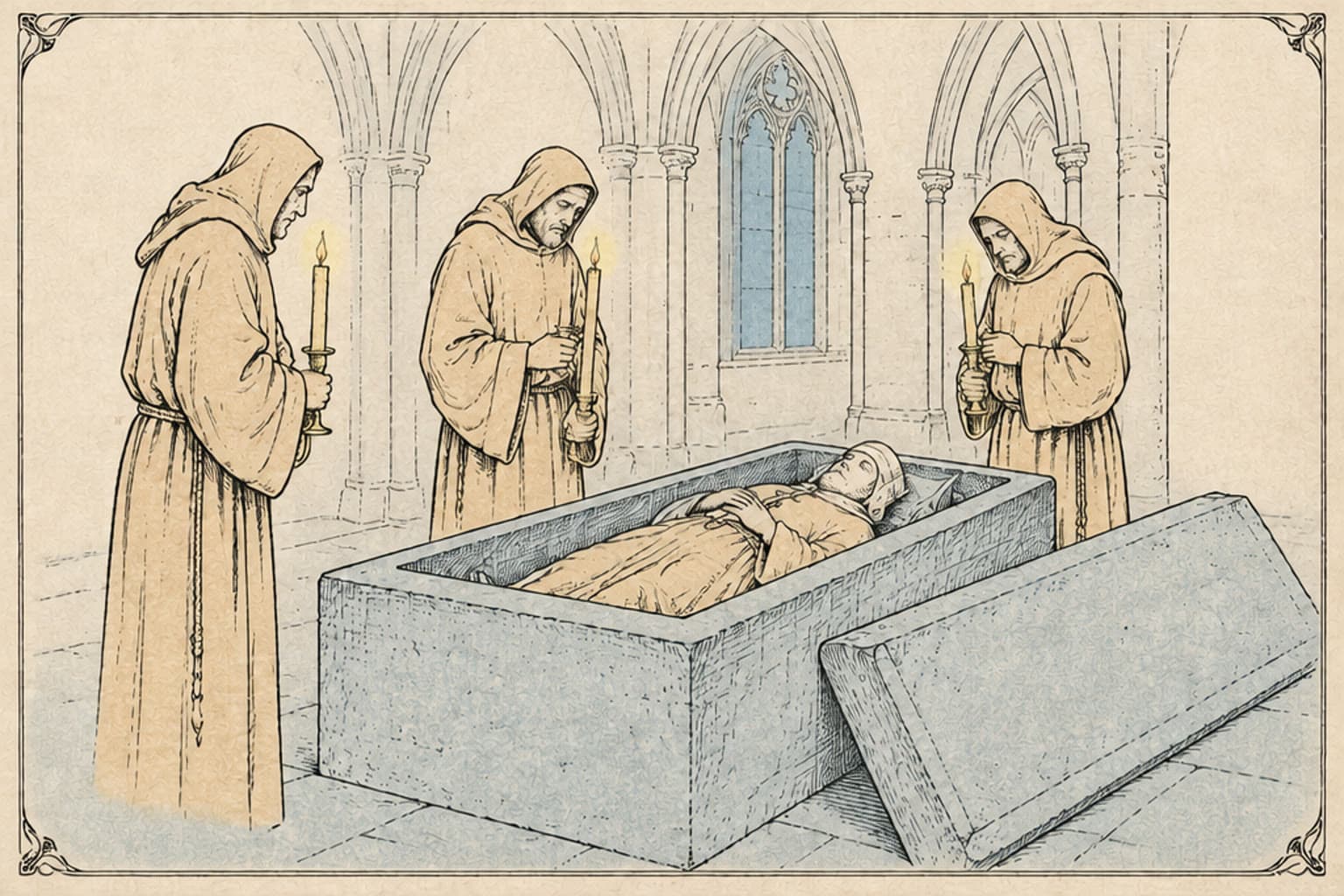
A skeleton found inside a Roman stone coffin at Westminster Abbey belongs to a man who died in the late Saxon period, not Roman times. Radiocarbon dating places his death between 987 and 1052. Warwick Rodwell, the abbey's consultant archaeologist, reports the findings in the Journal of the British Archaeological Association.
The limestone coffin carries a Latin inscription naming Valerius Amandinus, a Briton of the fourth century. It reads that Valerius Superventor and Marcellus made it for their father. A large cross, carved on the lid in the tenth or eleventh century, shows the coffin was taken over for a later burial.
The date of the original find is reported differently. Live Science gives 1869, when the abbey's chief mason uncovered it. Archaeology Magazine places the discovery of remains in 1820. Either way, the grave had been looted in the nineteenth century, and for generations no one expected bones to survive inside.
That changed in 2016, when the coffin was opened for conservation and a nearly complete skeleton appeared. Bioarchaeologist James Langthorne of Pre-Construct Archaeology found a man of average height, about five feet nine inches, aged roughly 35 to 49. He showed osteoarthritis, gout and two healed rib injuries. The bones were out of order and the skull had a hole, damage from earlier disturbance.
White residue inside the coffin outlined a rectangle. Rodwell reads it as the trace of a wooden coffin that has rotted away, and the residue itself as lime scattered over the body at burial.
Rodwell argues the man was almost certainly an abbot, given the dignified burial under a large cross. He narrowed the candidates using the abbots' dates of office. Wulfsige left to become a bishop elsewhere and was probably buried elsewhere. That leaves Ælfwig, abbot until 1020, and Wulfnoth, who held the post until 1049. Ælfwig had already been a Westminster monk, which Rodwell says may favour him.
Open questions remain. Reuse of a Roman coffin is very rare, and nothing comparable is known. Rodwell notes that the inscription opens with a word meaning "to the memory," which may point to an early Christian. The limestone came from Oxfordshire, and where the coffin stood originally is unknown. Rodwell suggests a Roman villa and cemetery could still lie near the abbey.
The case shows how an object can carry several lives at once. A Roman family's memorial became a Saxon abbot's tomb, and reading it correctly required both the inscription and the scientific dating of the bones.
Compiled from the reports below. Read the originals.
Sources
- October 20, 2026Live ScienceCase of mysterious medieval skeleton buried in Roman-era sarcophagus at Westminster Abbey finally solved
- October 23, 2026Archaeology MagazineRoman Sarcophagus at Westminster Abbey Likely Held Remains of Medieval Monk