There is a shape standing over almost every town square and almost every church lawn in the Western world, and most people have walked past it their whole lives without asking where it came from. It is tall, four-sided, tapered, and it ends in a point. We call one version an obelisk and set it in a city plaza. We call the other a steeple and set it on a sanctuary roof. The symbolism behind both of these forms traces back to a single place and a single god, long before either one stood in a Western city. Trace both shapes back far enough, and you find they are the same object, carved first in Egypt for a purpose that had nothing to do with the worship of Yahuah.
What follows is not a case against any building or any congregation. It is a walk through the history of a shape, from the temple at Heliopolis to the square in Rome to the skyline of an ordinary town, so the symbol can finally be seen for what it has always been.
The Shape with a Forgotten Address
Before tracing where this symbol traveled, you need to see it as an object with a specific, documented origin point. It did not start as architecture. It started as theology carved into rock.
What an Obelisk Is
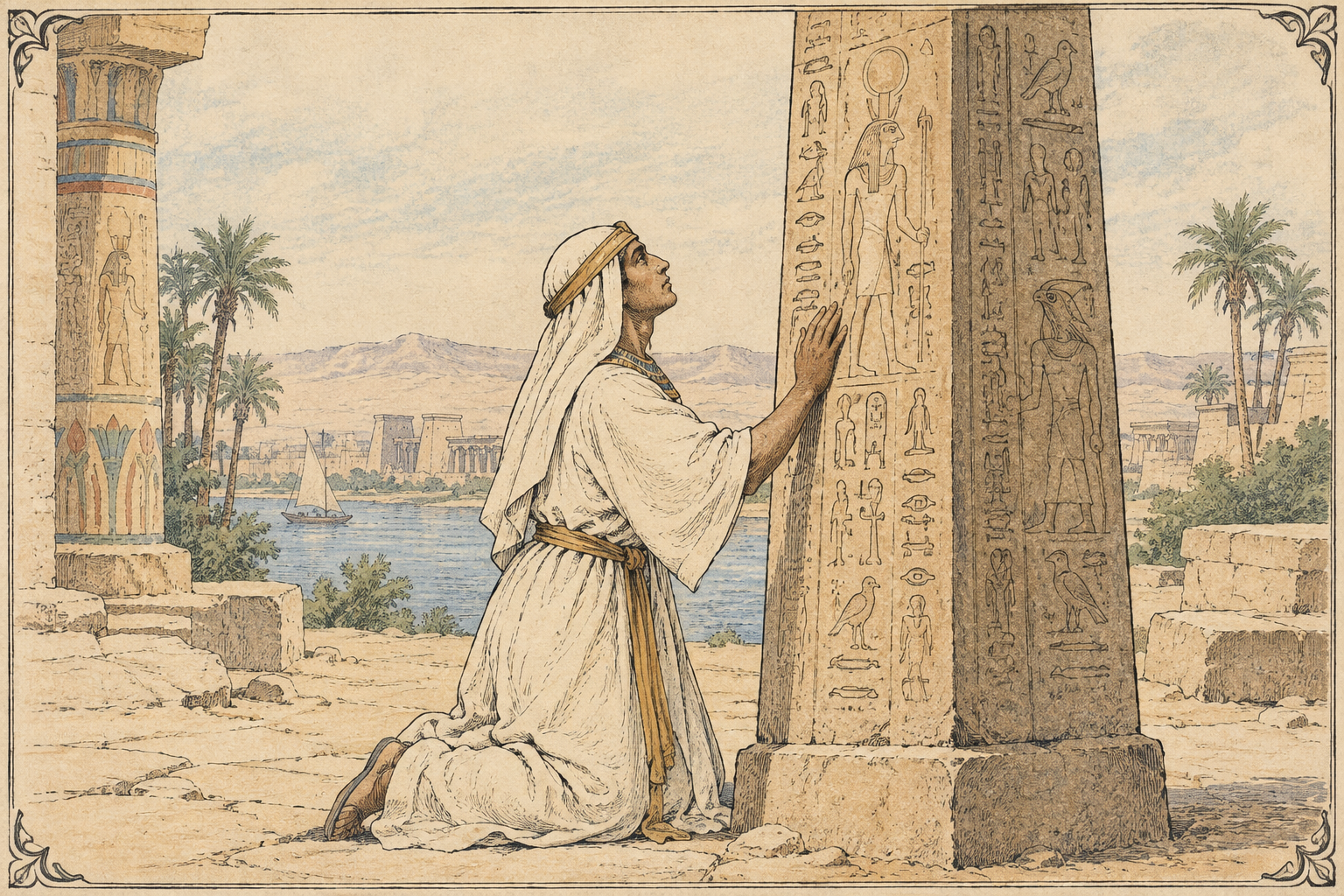
An obelisk is not a general-purpose monument. It is a single shaft of stone, cut as one continuous piece, four-sided, tapering gradually as it rises, and capped with a small pyramid-shaped tip called a pyramidion. Egyptian stonecutters quarried these from single blocks of granite, sometimes weighing hundreds of tons, and transported them whole rather than assembling them from parts. The entire form, base to tip, was conceived as one unbroken piece of stone standing upright.
That detail matters. An obelisk is not a tower you build up course by course. It is a single, solid, upright shaft, deliberately shaped to taper as it rises to a point. Hold that image. You will need it later when you look at a church roofline.
Heliopolis, the City of the Sun
The obelisk's home address was Heliopolis, a city whose name means "city of the sun." Heliopolis sat near modern Cairo and served as the center of Egyptian solar worship, the cult of Ra. Obelisks were raised at the entrances to sun temples there, not as decoration but as objects of devotion, markers of a theology that centered on the sun as a manifestation of divine power.
The obelisk was never a neutral architectural choice the way a column or an arch might be. It was raised at a specific religious site, for a specific god, as part of a specific system of worship. Every obelisk that left Heliopolis carried that address with it, whether anyone remembered it or not.
A Shape Built to Be Noticed
Egyptian builders capped many obelisks in electrum or gold leaf, a metal alloy that would catch the first light of sunrise and throw it back across the temple complex. The height, the tapering shaft, and the gleaming tip were not incidental design choices. They were a theological statement built in stone: here is a shaft that reaches toward the sun and receives its light before anything else in the city does.
The obelisk was built to be seen, built to catch light, built to draw the eye upward toward the sky. That upward reach was the whole point. Once you understand what the Egyptians believed that shape represented, the design choice becomes even more pointed.
Osiris, Dismembered, and What Could Not Be Found
To understand what the obelisk was built to represent, you have to walk through the central myth of Egyptian religion itself. This is not a tangent. This is the source material.
Set's Betrayal and the Scattering of the Body
In the Osiris myth, central to Egyptian religious life for thousands of years, Osiris ruled as a benevolent king of Egypt until his brother Set grew jealous of his power. Set murdered Osiris, sealed him inside a coffin, and later, in the fuller tradition of the story, cut his body into pieces and scattered them across the land of Egypt. Osiris became, from that point forward, the god of the underworld and the dead, a ruler whose body had been broken apart and spread across the land his worshippers lived on.
This was not a minor side story in Egyptian religion. The Osiris myth sat at the center of how Egyptians understood death, kingship, and the afterlife. Every Pharaoh was buried with rites meant to identify him with Osiris, the god whose body had been torn apart and who nonetheless continued to reign.
Isis Gathers Everything but One Piece
Osiris's wife and sister, Isis, searched Egypt to recover the scattered pieces of his body. She found and reassembled every part. Every part except one. The phallus of Osiris, in the tradition as it has come down to us, could not be found. Some versions say it had been thrown into the Nile and swallowed by a fish.
Osiris's body is whole again in this myth, except for the one part that makes new life possible, and that part is simply gone.
A Replacement Fashioned from Stone
The myth then does something worth pausing on. Isis, unable to recover the lost piece, fashions a replacement. She forms a substitute, and through it she conceives Horus, the god who will avenge his father and inherit his throne. The missing piece is not mourned and left absent. It is remade and set in its place.
Here is how The Bible Gazette reads the obelisk: it is that piece, remade in monumental stone and raised for good at the temple gate. No ancient priest wrote the connection down in so many words. The shape says it anyway. A single upright shaft, set at the threshold of a sun temple, for the god whose missing member had to be remade so that life could go on.
Scripture Does Not Leave This Ambiguous
Move now from Egyptian religion to the Hebrew Bible, and notice something striking: the biblical authors do not treat these pillars as curiosities. They name them and they condemn them.
Jeremiah Names the House of the Sun
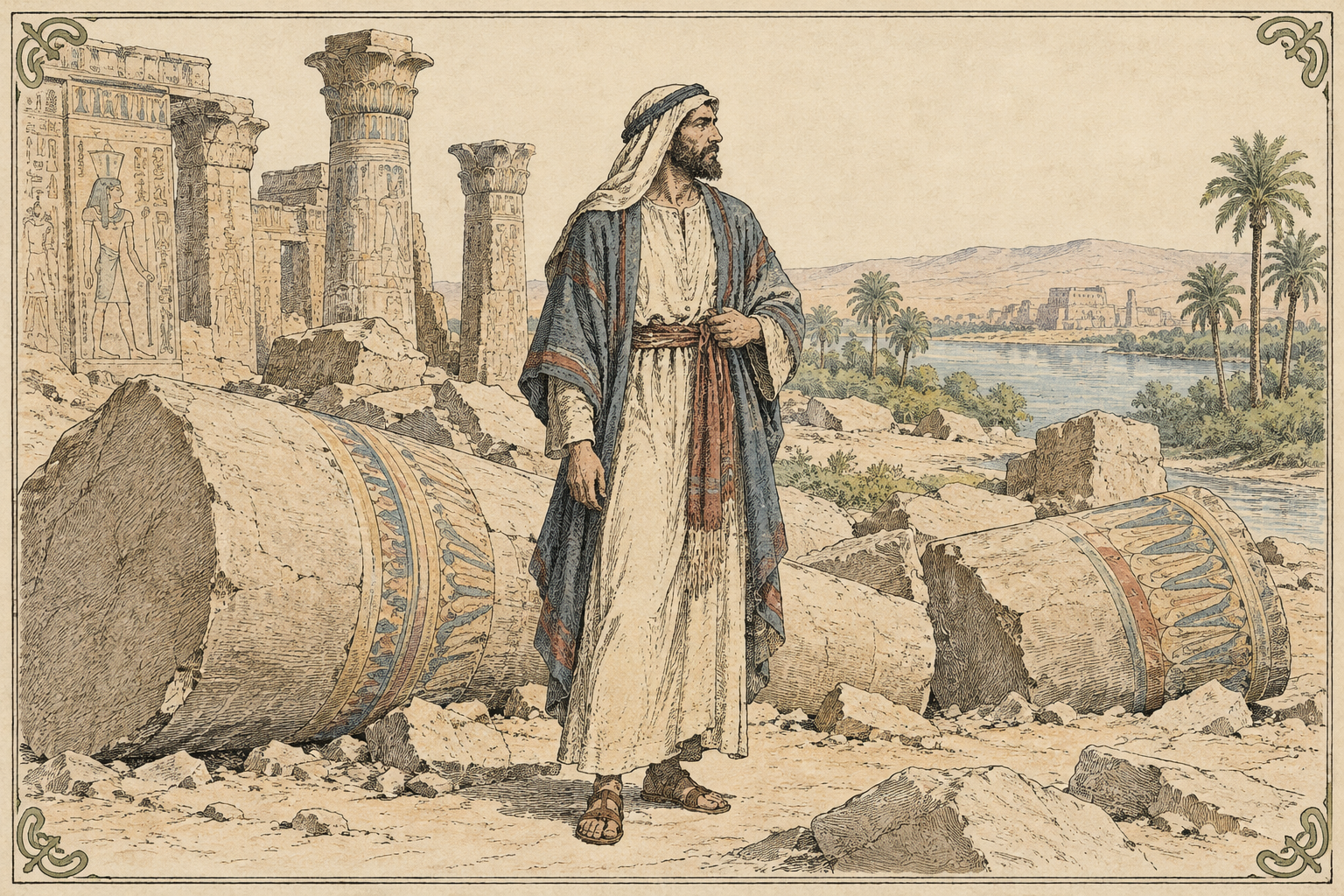
Jeremiah 43:13 is specific. The prophet declares that Yahuah will break "the obelisks of Beth-shemesh, that is in the land of Egypt." Beth-shemesh means "house of the sun," a Hebrew name pointing directly at Heliopolis, the city of solar worship itself. Jeremiah is not speaking in generalities about Egyptian idols. He names the city, names its meaning, and names the standing stones raised there, and he says Yahuah himself will shatter them.
This matters because it shows the biblical writers knew exactly what these obelisks were and where they stood. Jeremiah 43:13 is not an obscure verse. It is a direct prophetic address to a specific object standing in a specific city devoted to a specific god, and the verdict on it is demolition.
The Word Matstsebah: A Hebrew Word Study
Let's trace a word. Deuteronomy 16:22 commands, "Neither shall you set up a matstsebah, which Yahuah your Alohim hates." The Hebrew word here is matstsebah, built from the root natsab, meaning "to stand" or "to station upright." A matstsebah is a standing pillar, a stone set erect and fixed in place as an object of religious significance.
This word names something specific: an upright, erected pillar, the kind of standing stone that Canaanite and Egyptian religion used at sacred sites throughout the ancient Near East. When Deuteronomy says Yahuah hates the matstsebah, it is naming a recognizable category of object, the same category the obelisk belongs to: a single stone, raised upright, standing as a fixed marker of devotion. This is the Bible's ban on sacred pillars at its clearest. The command is not abstract. It targets a known physical form.
A Pattern, Not an Isolated Verse
Put Jeremiah and Deuteronomy side by side and a pattern emerges. Deuteronomy establishes the legal prohibition: do not raise a matstsebah, a standing sacred pillar. Jeremiah then shows that prohibition applied with full force to an actual object in an actual city: the obelisks of Beth-shemesh, the house of the sun, which Yahuah himself promises to break.
This is not one strange verse floating alone in the text. It is two witnesses, from two different eras of Israel's history, naming the same category of object and condemning it in the same terms. The biblical authors were not confused about upright sacred pillars. They saw them plainly, named them specifically, and ruled them out without hedging.
Rome Collects What Egypt Raised
The obelisks did not stay in Egypt. Their physical journey into the heart of the Western world is a matter of plain historical record.
Emperors Ship the Stones Across the Sea
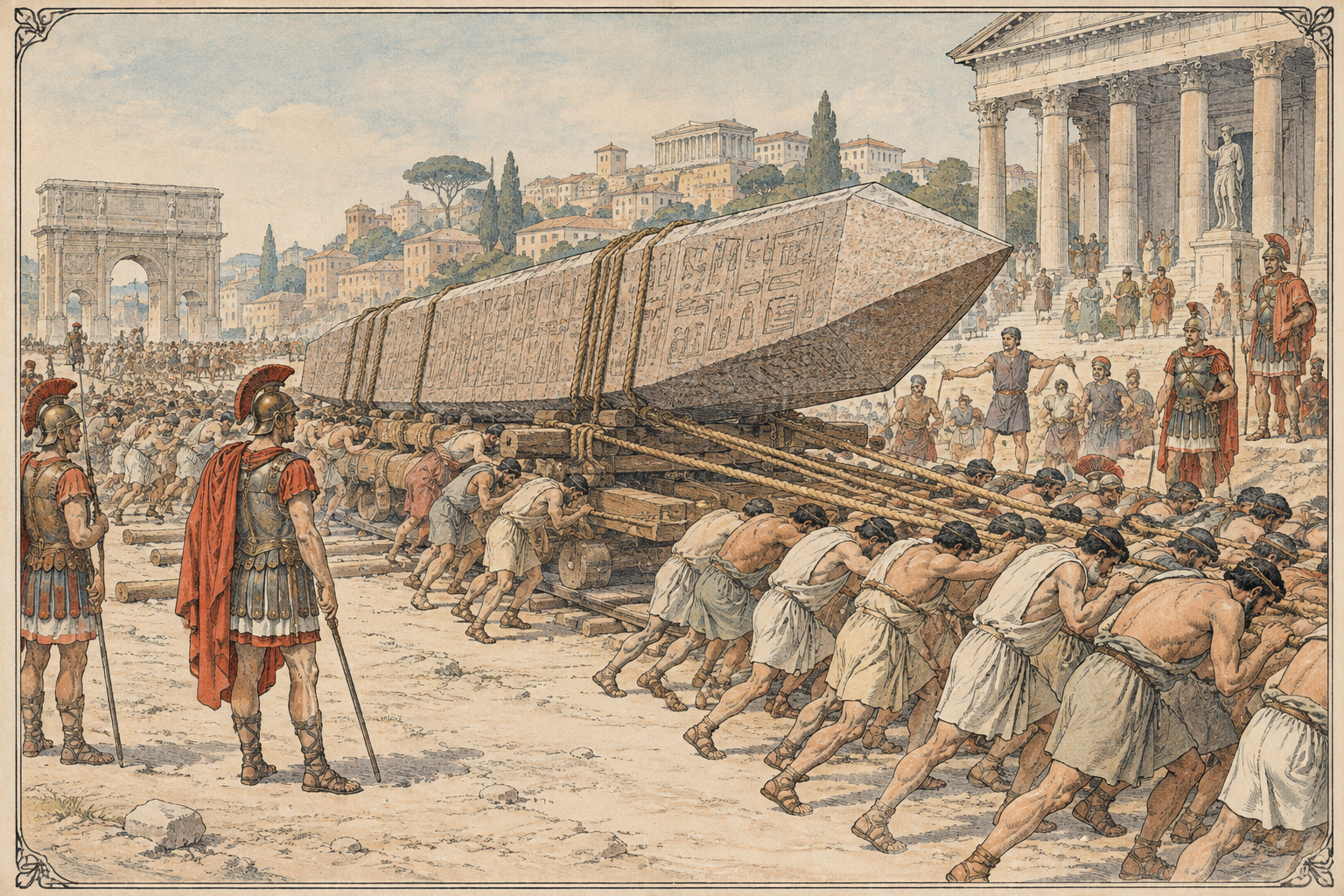
Beginning under Augustus and continuing through later emperors, Rome transported Egyptian obelisks across the Mediterranean by the dozen. These massive single-stone shafts were loaded onto specially built ships, hauled across the sea, and re-erected in Roman circuses, forums, and public spaces as trophies of conquered Egypt. Rome did not destroy these stones. Rome collected them, prizing them as symbols of imperial reach and solar grandeur, Egyptian religious architecture physically relocated into the center of the empire.
Today more ancient Egyptian obelisks stand in Rome than in Egypt itself. The city made a habit of this. Conquered religious monuments became imperial trophies, erected again in new squares for a new audience, their original meaning intact even as their original setting disappeared.
Sixtus V and St. Peter's Square
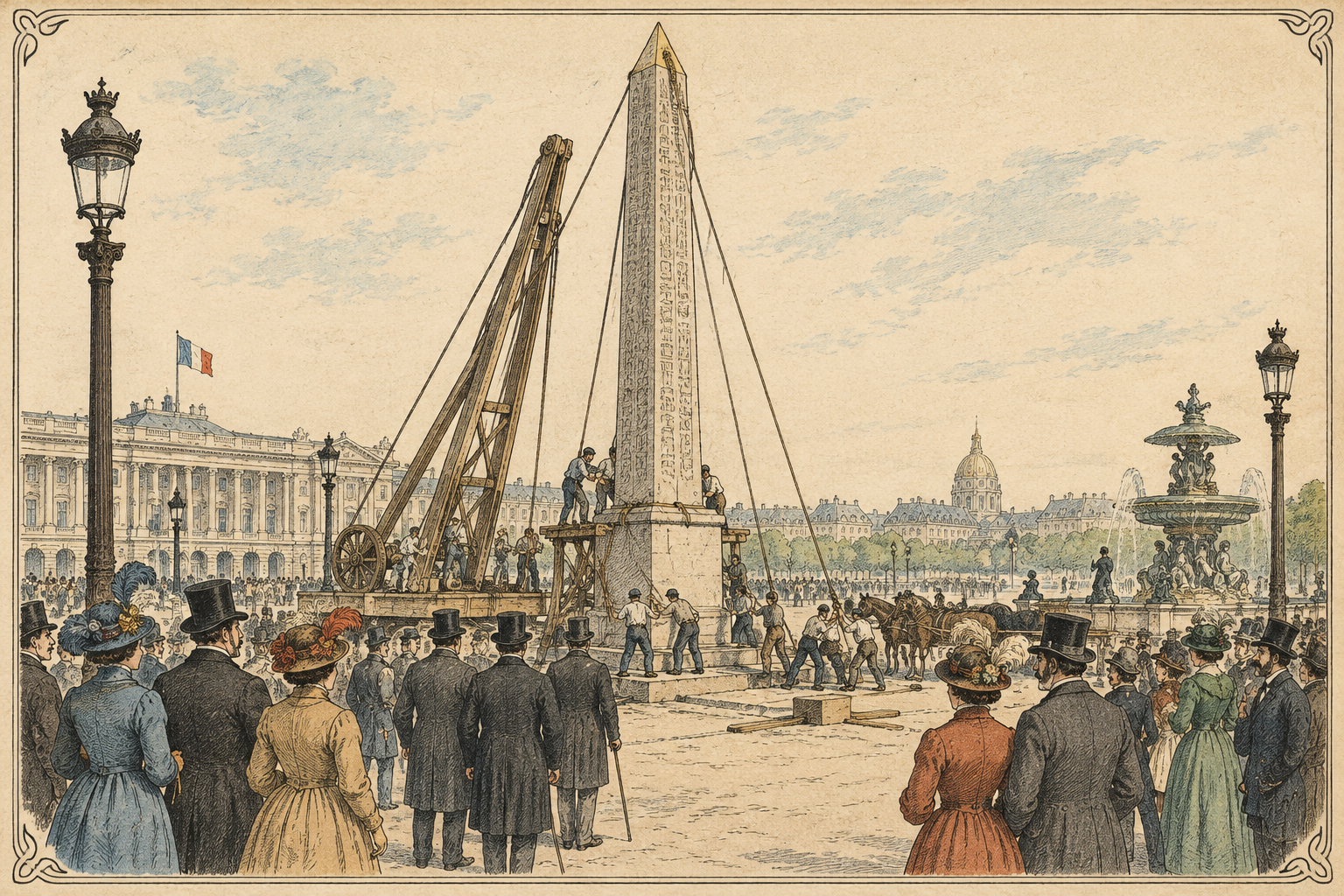
Centuries later, around 1586, Pope Sixtus V undertook one of the most ambitious engineering projects of the Renaissance: re-erecting the Vatican obelisk in the center of St. Peter's Square. The obelisk Sixtus V moved had originally stood in Heliopolis before Emperor Caligula shipped it to Rome to adorn his circus. It had stood in Roman soil for over fifteen centuries by the time Sixtus V decided to move it to the heart of the Vatican. The engineering feat required hundreds of men, dozens of horses, and nearly a year of planning. When it was finished, the same single shaft of Egyptian granite, tapered and pointed exactly as it had been cut in Egypt, stood at the center of the most visible square in Western Christianity. The Vatican obelisk Pope Sixtus V raised in 1586 still stands there today, unmoved since.
Not Christianized, Only Relocated
The distinction is worth making plainly. Sixtus V did not redeem this symbol or reinterpret its form. He added a cross to its tip and inscribed Christian phrases at its base, but the shaft itself, the tapered granite body that Egyptian priests had cut for a sun temple, remained exactly what it had always been. A cross on top of an Egyptian obelisk does not change the obelisk into a different object any more than a hat on a statue changes the statue underneath it.
Popes in Rome did not transform the symbol's meaning. They normalized its presence. They took an object built for Heliopolis and carried across the sea for Roman circuses, and they set it at the literal center of Western Christian life. Millions of visitors now walk past it every year, assuming it must mean something Christian simply because of where it stands. The shape was never baptized; it was only relocated and surrounded with new company.
The Same Shape Rises Over Your Street
Now bring this home, to a building almost nobody in the Western world questions: the ordinary church with a steeple on its roof.
From Temple Gate to Church Lawn
Look again at the obelisk's basic form: a single shaft, four-sided, tapering gradually upward, ending in a point aimed at the sky. Now look at a church steeple. The architectural continuity is not subtle once you see it: tapered walls narrowing as they rise, four sides in most traditional designs, a pointed tip reaching skyward, often capped with something gleaming, a cross, a weathervane, a ball and spire catching the light exactly as the gilded pyramidion once did at Heliopolis. The tapered stone shaft that once stood at Egyptian temple gates reappears, nearly unchanged, over the entrance of a church building built two thousand years and six thousand miles removed from its source.
Church steeples developed historically through a blend of influences, including defensive towers and bell towers in medieval Europe. But the pointed, tapering, upward-reaching form that became the standard silhouette of Western church architecture did not emerge from nothing. It emerged in a civilization already saturated with obelisks standing in its capital, obelisks whose form had been normalized for over a thousand years by the time church architecture took its familiar shape.
A Symbol Hidden by Familiarity
A symbol like this survives for thousands of years without being questioned through repetition and distance from origin. Nobody walking past a church steeple today thinks about Heliopolis. Nobody attending Sunday service considers Set, Isis, or the missing piece of Osiris's body. The form has traveled so far from its address that the address itself has been forgotten.
This is the ordinary way symbols travel. A shape gets separated from its myth, planted in new soil, surrounded by new meaning, and within a few generations nobody remembers to ask where it came from. The steeple's pagan origin is not hidden because someone is actively concealing it. It is hidden because familiarity is the best camouflage a symbol can have.
Looking at a Familiar Skyline with Fresh Eyes
Walk through your own town sometime and count the steeples. Then think about the obelisks standing in Washington, D.C., in Paris, in London, in Buenos Aires, in city after city across the Western world, almost always unnoticed, almost always assumed to be purely decorative or historical. Trace the line from Heliopolis, where the shape first rose at a sun temple, through Rome, where emperors collected it and popes re-erected it, to the lawn outside the church down the street. It is one unbroken line, carried in stone.
Seeing the Shape, and Worshipping the One Who Made the Sun
None of this is an argument against any building, and it is not a reason to shame anyone who gathers under a steeple to pray or sing or hear Scripture read aloud. The people sitting in those pews are not responsible for the shape of a roofline chosen centuries before they were born. This is a call to see, not a call to condemn.
But seeing matters. The Osiris symbolism traced through this history is not a conspiracy theory or a stretch of imagination. It is a documented path: a shape born at a sun temple in Heliopolis, tied to a myth about a god's body torn apart and a missing piece remade, carried by conquering emperors to Rome, re-erected by popes in the center of Western Christian life, and echoed in nearly identical form on church rooflines across the world. The stone was never redeemed; it was only moved, admired, and eventually forgotten.
Yahuah broke the obelisks of Beth-shemesh because they represented devotion to the sun rather than to the Creator who made it. That same Creator does not need a tapered shaft reaching toward the sky to be worshipped rightly. He asks for hearts, not silhouettes. Wherever you stand this week, under a steeple or in an open field, look up with fresh eyes, and let your devotion rest on the one who made the sun itself, not on any shape raised to it.