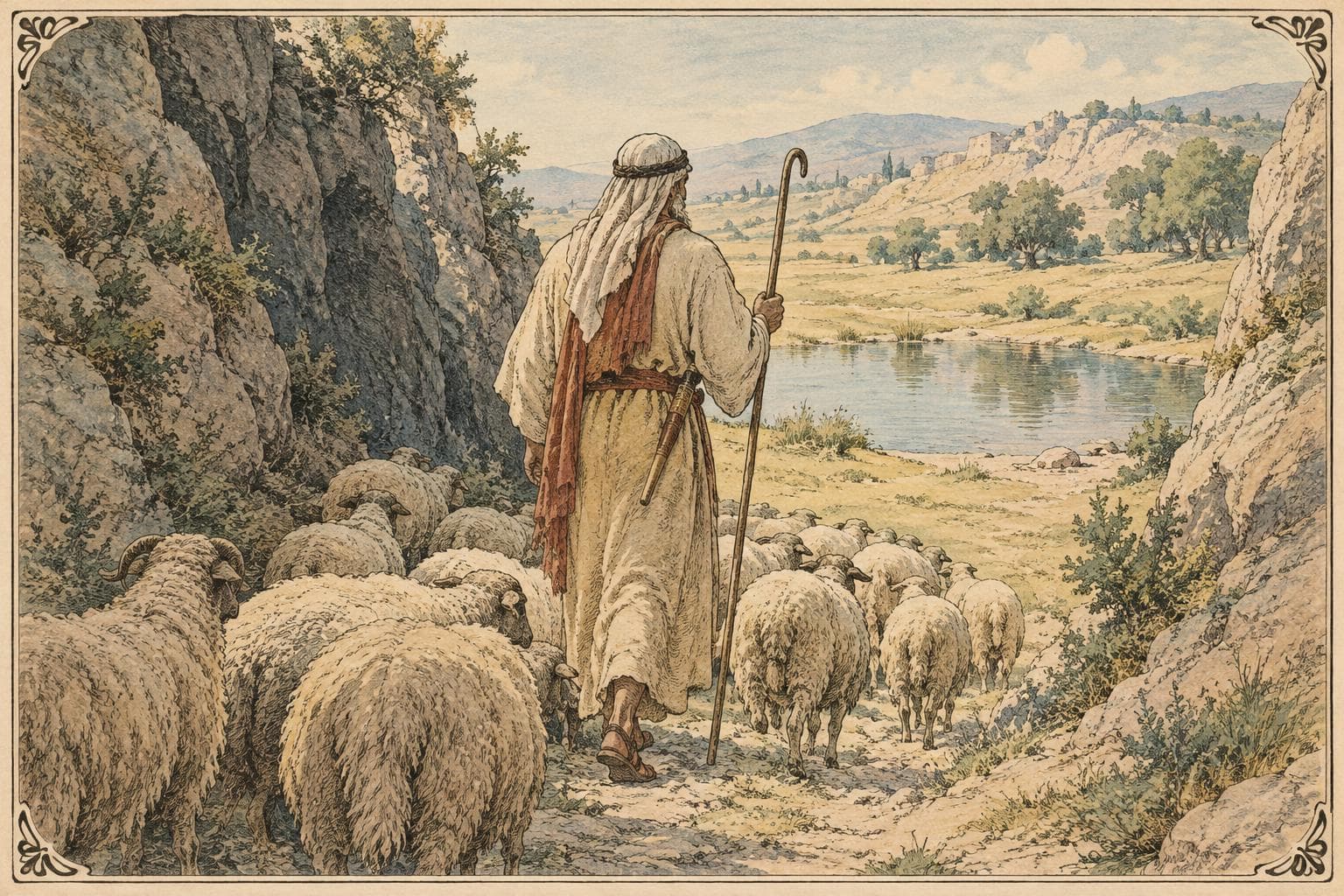
Matthew stops his narrative, mid-sentence almost, to tell us what a man was wearing. "Now John wore a garment of camel's hair, with a leather belt around his waist, and his food was locusts and wild honey" (Matthew 3:4). It is an odd place for a wardrobe note. The Gospel writer has announced the arrival of the messenger who prepares Israel for the kingdom of heaven, and before he tells us a single word John preached, he tells us what John wore. Modern readers tend to file this under atmosphere, the kind of detail a documentary filmmaker inserts to make a scene feel authentic. But the John the Baptist Elijah connection hiding in plain sight here would have stopped a first-century Judean reader cold. They would have recognized the outfit before finishing the verse, because they had read about it before, in a scene nearly nine centuries older than Matthew's Gospel.
That recognition is the whole argument of this piece. The camel's hair and the leather belt work as a citation.
The Garment That Needed No Introduction
A Gospel Writer Does Not Waste Ink
Papyrus was expensive, and the Gospels are short books that leave out a great deal. When Matthew and Mark both pause to describe John's clothing, in nearly identical language, that choice tells us something. Mark's Gospel moves at a sprint. He uses the word "immediately" over forty times, rushing from scene to scene with almost breathless economy. Yet even Mark slows down for this. "John was clothed with camel's hair and wore a leather belt around his waist" (Mark 1:6). And Matthew, who trims a good deal of Mark's material, keeps this detail rather than cutting it.
A writer who is economical with ink does not spend it on nothing. The clothing is doing work in the story. The question is what kind of work.
Reading With Second Temple Eyes
Here is where the gap between ancient and modern reading habits becomes important. We read Matthew the way we read a novel, following plot and character, skimming description. Second Temple Judeans read their Scriptures the way a musician reads a score, catching allusions, recognizing phrases lifted whole from older texts, hearing echoes we have to work to recover. Their entire imaginative world was built from the Hebrew Scriptures, read aloud in synagogue week after week, memorized by the devout, woven into daily speech. A description that strikes us as neutral reportage would have struck them as a direct quotation.
This is not a minor point of literary technique. It is the difference between missing Matthew's argument entirely and seeing it plainly. The meaning of the camel's hair and leather belt only becomes visible once we read the way Matthew's first audience read, scripture pressed against scripture, until the older story lights up the new one.
Malachi's Unfinished Promise
The Day of the Lord and the Prophet Who Prepares It
The last book of the Christian Old Testament, which also closes the Book of the Twelve Prophets, ends with a promise that Israel had not yet seen fulfilled. "Behold, I will send you Elijah the prophet before the great and awesome day of the Lord (YHWH) comes. And he will turn the hearts of fathers to their children and the hearts of children to their fathers" (Malachi 4:5-6). Malachi names Elijah himself, and that sharpness is what made the expectation so vivid to Second Temple readers. The prophet is to come before a day of reckoning so serious that Malachi calls it both great and dreadful.
The same book had already planted the seed a chapter earlier. "Behold, I send my messenger, and he will prepare the way before me. And the Lord whom you seek will suddenly come to his temple" (Malachi 3:1). This is the verse the Gospel writers will later apply to John directly. A messenger clears the road. Then the Lord himself arrives, without warning, at his own house. Put the two promises together and Malachi has given Israel an unfinished sentence: a forerunner is coming, and behind him, Israel's God (Alohim).
Four Centuries of Waiting
Mark opens his entire Gospel by reaching for this promise. "As it is written in Isaiah the prophet, 'Behold, I send my messenger before your face, who will prepare your way, the voice of one crying in the wilderness: Prepare the way of the Lord, make his paths straight'" (Mark 1:2-3). Mark blends Malachi 3:1 (with an echo of Exodus 23:20) and Isaiah 40:3 into a single quotation, which tells us he read them as one promise, one expectation, one unresolved thread running through the whole prophetic corpus.
That thread had not gone cold by the first century. The book of Sirach, written roughly two centuries before Jesus (YHWShA), praises Elijah in language drawn from Malachi and Isaiah: "At the appointed time, it is written, you are destined to calm the wrath of God before it breaks out in fury, to turn the hearts of parents to their children, and to restore the tribes of Jacob" (Sirach 48:10). Whoever wrote that sentence was not reminiscing about ancient history. He was describing a job still open, a prophet still expected. The hope of Elijah's return shows up in Sirach, in the Dead Sea Scrolls, and in the scribes' own saying that "Elijah must come first" (Mark 9:11). It was alive among the crowds who would later stream out to the Jordan to see John.
The Outfit That Named Elijah Without a Name
What Ahaziah's Messengers Saw
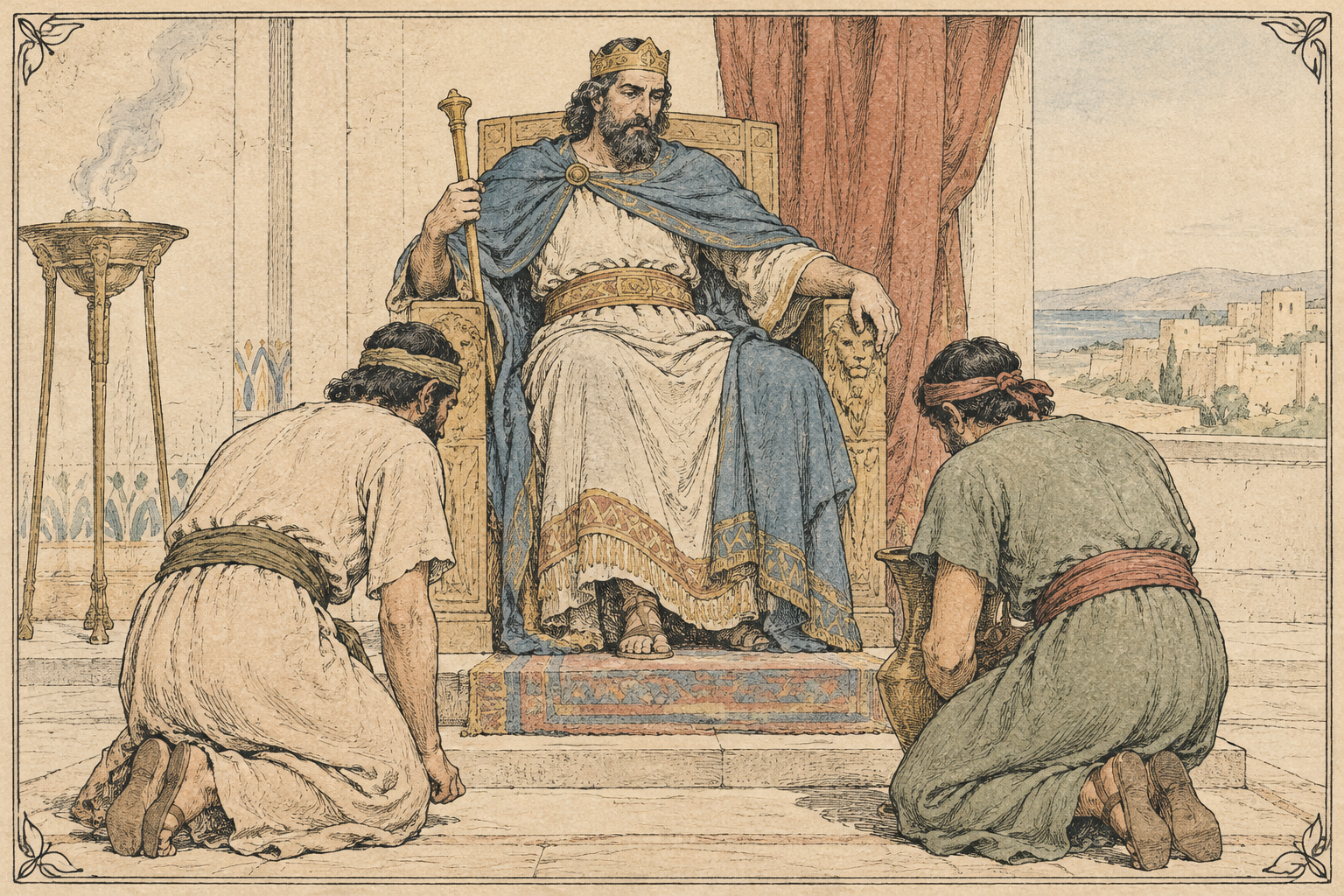
Now turn back further, to the ninth century BC, to a scene in 2 Kings that Matthew's description all but transcribes. King Ahaziah, injured and dying, sends messengers to consult a foreign god about his recovery. A prophet intercepts them on the road and sends them home with a different message entirely: the king will die, because he sought a foreign god instead of the God of Israel. Ahaziah, baffled, asks his messengers what the man looked like. "They answered him, 'He wore a garment of hair, with a belt of leather about his waist.' And he said, 'It is Elijah the Tishbite'" (2 Kings 1:7-8).
Read that exchange slowly. The messengers give no name. All they offer the king is a description, hair garment, leather belt, and that description alone is sufficient. Ahaziah does not ask a follow-up question. He does not need one. The clothing functions as a signature, as unmistakable as a face. In a culture before photographs, before widely circulated portraits, clothing carried identity the way a uniform does today. See the belt and the coat, and you already know who stands before you.
Matthew's description of John echoes this scene. The hair garment marks a prophet, and the leather belt names Elijah: in the Greek Bible that Matthew's readers knew, the phrase for a leather belt around the waist repeats 2 Kings almost word for word. The parallel is too exact to be an accident of common wardrobe among wilderness ascetics. Matthew is quoting 2 Kings, the way a modern writer might describe a man in a red cape and know every reader would think of a specific comic book hero without needing to name him.
A Prophet's Uniform Across the Centuries
A fair question deserves an honest answer here. The Hebrew phrase behind "a garment of hair" in 2 Kings 1:8 admits of two readings. It can mean a man wearing a hairy garment, or, read slightly differently, a hairy man, someone simply covered in natural body hair or an unkempt beard. Scholars have argued both sides for a long time, and the ambiguity is real. I will not pretend otherwise.
But the ambiguity does not damage the case Matthew is making. It barely touches it. Centuries after Elijah, the prophet Zechariah assumes that a "hairy cloak" had become recognized prophetic dress, worn by genuine prophets and, tellingly, by frauds hoping to pass themselves off as genuine. "On that day every prophet will be ashamed of his vision when he prophesies. He will not put on a hairy cloak in order to deceive" (Zechariah 13:4). By Zechariah's day, whatever the original Hebrew of 2 Kings meant, the hairy mantle had become shorthand for the office itself, the uniform of a man claiming to speak for God. Matthew's first readers, steeped in that later tradition as much as the earlier one, would have read John's clothing as a deliberate, visible claim. He is not dressed this way by accident of poverty or personal taste. He is dressed this way on purpose, so that Israel will know exactly who stands before them at the river.
Is John Elijah, or Something More Precise?
Jesus' Testimony Versus John's Denial
A careful reader will have noticed a wrinkle by now, and it deserves to be addressed directly rather than smoothed over. Jesus speaks of John in terms that sound, on the surface, like flat identification. "And if you are willing to accept it, he is Elijah who is to come" (Matthew 11:14). Later, descending the mountain after his transfiguration, Jesus tells his disciples plainly that "Elijah has already come, and they did not recognize him, but did to him whatever they pleased," and Matthew adds that the disciples understood he was speaking of John (Matthew 17:10-13).
Yet the identification runs into an obstacle, straight from John's own mouth. Asked point blank by the priests and Levites sent from Jerusalem, "Are you Elijah?" John answers flatly: "I am not" (John 1:21). So which is it? Does the Gospel of John contradict Matthew, or does John simply not know who he is?
Spirit and Power, Not Reincarnation
The resolution was supplied before John ever opened his mouth in ministry, in the announcement given to his father before his birth. The angel tells Zechariah that his son "will turn many of the children of Israel to the Lord their God, and he will go before him in the spirit and power of Elijah, to turn the hearts of the fathers to the children" (Luke 1:16-17). Note the precision of that phrase. Not Elijah. In the spirit and power of Elijah. Luke's phrase gives us the category Matthew and John are both working within, and it resolves the apparent conflict.
John is denying that he is the ninth-century prophet himself, returned from heaven, where he had been taken up without dying (2 Kings 2:11). That is a reasonable thing to deny, and he denies it truthfully. But Jesus is not making that claim about him either. What Malachi promised was not a reincarnation but a role, a function, a job description: a forerunner clothed in Elijah's authority, carrying Elijah's fire, sent to do in his generation what Elijah did in his. John fills that role so completely that Jesus can say, without contradiction, that Elijah has come. Both statements are true at once, because they are answering different questions. This step sharpens the identification, because it shows the Gospel writers were working with a precise theological category rather than a vague poetic gesture.
The Same Call to Turn Hearts
Carmel and the Turning of a Divided Nation
Elijah's defining confrontation happens on Mount Carmel, where he stands alone against four hundred and fifty prophets of Baal and puts a direct question to a nation that had been hedging its bets between two gods. "How long will you go limping between two different opinions? If the Lord is God, follow him; but if Baal, then follow him" (1 Kings 18:21). Before the fire falls, Elijah prays, and his prayer names the purpose of the entire episode in a single line: "you have turned their hearts back" (1 Kings 18:37). Then fire falls from heaven and consumes the sacrifice, and the people fall on their faces and confess, "The Lord, he is God" (1 Kings 18:39). Turning the heart is the same idea Malachi will later attach to Elijah's return at the end of the age.
The River and the Same Summons
John stands at a different body of water nine centuries later and issues the identical summons. "Repent, for the kingdom of heaven is at hand" (Matthew 3:2). Luke gives us the texture of what that repentance looked like in practice, tax collectors told to collect no more than they are authorized, soldiers told not to extort money by threats, the crowd told to share what they have with those who lack (Luke 3:3-14). This is not abstract piety. It is the turning of ordinary hearts toward ordinary neighbors, fathers reconciled to children in the most concrete, unglamorous sense. Malachi's promise is being fulfilled in real transactions between real people on a riverbank, which is exactly where a promise about turning hearts ought to land.
The Same Throne, The Same Hostility
A King Who Bends and a Queen Who Will Not Relent
Every true prophet in Israel's story eventually meets a throne that cannot tolerate him, and the pattern that forms around Elijah repeats with unsettling precision around John. Fresh from Carmel, Elijah learns that Ahab's wife Jezebel, enraged at his triumph over her prophets, has sworn to take his life "by this time tomorrow" (1 Kings 19:2), and he flees into the wilderness. Later he confronts Ahab over the seizure of Naboth's vineyard, a murder Jezebel arranged, and pronounces judgment on the king and his house (1 Kings 21). Ahab himself is weak rather than fully cruel, a man who bends to pressure and regrets his worst decisions after the fact, but he lacks the spine to shield the prophet from his wife's fury.
Centuries later, John confronts Herod Antipas over his unlawful marriage to his brother's wife. Herodias, stung by the rebuke, nurses her grudge until an opportunity arrives at a banquet, and she uses her daughter to extract John's head on a platter (Mark 6:17-28, Matthew 14:3-12). Mark portrays Herod as reluctant, even glad to listen to John (Mark 6:20), distressed by the request yet too weak, or too proud before his guests, to refuse the request. A ruler who bends. A wife who will not relent.
The historian Josephus, writing from outside the Christian tradition entirely, confirms the arrest and the execution at the fortress of Machaerus, though he gives a political motive: Herod feared that John's hold on the crowds could spark an uprising (Antiquities 18.116-119). This is not a legendary flourish added by pious memory. It happened, in a specific fortress, at a specific king's order.
A Pattern Older Than Either King
Scripture does not treat this kind of repetition as mere historical coincidence, two unrelated stories that happen to rhyme. The biblical writers understood that behind human thrones stand spiritual powers hostile to the word of God. Daniel glimpses one, the "prince of the kingdom of Persia" resisting a messenger from heaven (Daniel 10:13), and Paul names them plainly: our struggle is "against the rulers, against the authorities" (Ephesians 6:12). Every generation produces its own Ahab, pliable and self-interested, and its own Jezebel, implacable once crossed, because the opposition to a true prophet is never finally about politics. It is about a word from God that someone in power cannot afford to hear. This pattern belongs entirely to the ancient world Elijah and John inhabited, and it is worth resisting the temptation to drag it into any modern argument. The text does its own work without our help.
The River Where Mantles Pass
Where Elijah Went Up and Elisha Took His Place
Geography in Scripture is rarely accidental, and the location of John's ministry confirms what his clothing, message, and enemies have already signaled. Elijah's earthly ministry ends at the Jordan. He strikes the water with his rolled-up cloak, the river parts, and he crosses with his successor Elisha close behind. On the far side, Elijah is taken up in a whirlwind, and Elisha, left standing alone, picks up the fallen mantle and strikes the water himself, asking "Where is the Lord, the God of Elijah?" before the river parts again for him (2 Kings 2:6-14). It is worth remembering that this was not the first time a leader's authority passed at that river. Moses's commission to Joshua reached its completion at the Jordan too, Israel's entire story turning, again and again, at this single crossing point.
Bethany Beyond the Jordan
John's Gospel places him at "Bethany beyond the Jordan, where John was baptizing" (John 1:28), on the far bank. Its exact site is debated, but early tradition set it opposite Jericho, the stretch of country where Elijah's authority had once passed to Elisha. It is there that John points to Jesus as the one who comes after him, and in the Jordan that Jesus is baptized (Mark 1:9), beginning his public work where the old story had once ended. The river that watched a mantle pass from one prophet to the next now watches something larger begin.
A Double Portion and a Greater One Still
Before Elijah is taken up, Elisha asks for a double portion of his spirit, the share the law gave a firstborn son (Deuteronomy 21:17), and he receives it (2 Kings 2:9-15). His ministry outran his master's, and later readers counted twice as many miracles in his story. John stands in the same posture of a forerunner making way for someone greater. "He must increase, but I must decrease" (John 3:30). And Jesus himself gives John the highest praise one human being can give another, before immediately relativizing it: "among those born of women none is greater than John. Yet the one who is least in the kingdom of God is greater than he" (Luke 7:28). Elisha received a double portion of a prophet's spirit. What follows John is not a double portion of anything. It is God himself, walking into the water.
John wore Elijah's clothes on purpose. He carried Elijah's message to a divided nation. He faced Elijah's enemies in the form of a bending ruler and a relentless royal wife. He stood at Elijah's river, the same water where mantles had passed before. Put those four lines of evidence together, along with Malachi's open promise and the Second Temple hope that still waited for its fulfillment, and the conclusion is no longer a matter of pious imagination. John as the promised Elijah is not a devotional flourish layered onto the text by later readers eager to find patterns. It is what Matthew is telling us, carefully, from the moment he describes a man in a camel's hair coat standing in the wilderness.
And if the promised Elijah has come, then the day he was sent to prepare has arrived, and the one he points toward is no mere teacher or reformer. Malachi said the Lord would come suddenly to his temple. John's camel-hair coat is the announcement that Israel's God has kept that word, arriving in person, in Jesus, at a river where an old story was always waiting to become new. The invitation Malachi gave Israel centuries earlier still stands open to anyone willing to read the clothing for what it is.